We are living through a crisis of interior life. The structures that once guided people through the thresholds of existence, through grief, loss, transformation and the death of old selves, have largely collapsed or been commercialised. In their place, a vast wellness industry offers the language of depth without requiring the descent. Healing is packaged as ascent. Transformation is promised without loss. The slow, unglamorous work of integration is replaced by the appeal of the instant.
At the same time, the capacity for interior life itself is eroding. Constant stimulation, algorithmic attention, the endless offer of someone else's world to inhabit - these do not simply distract us. They train us out of the ability to sit with discomfort, to follow a dream, to trust what cannot be immediately verified. And a person estranged from their own interior life is easier to manipulate, easier to sell to, easier to move without their noticing.
This is the cultural moment Noëmi Manser's work enters.
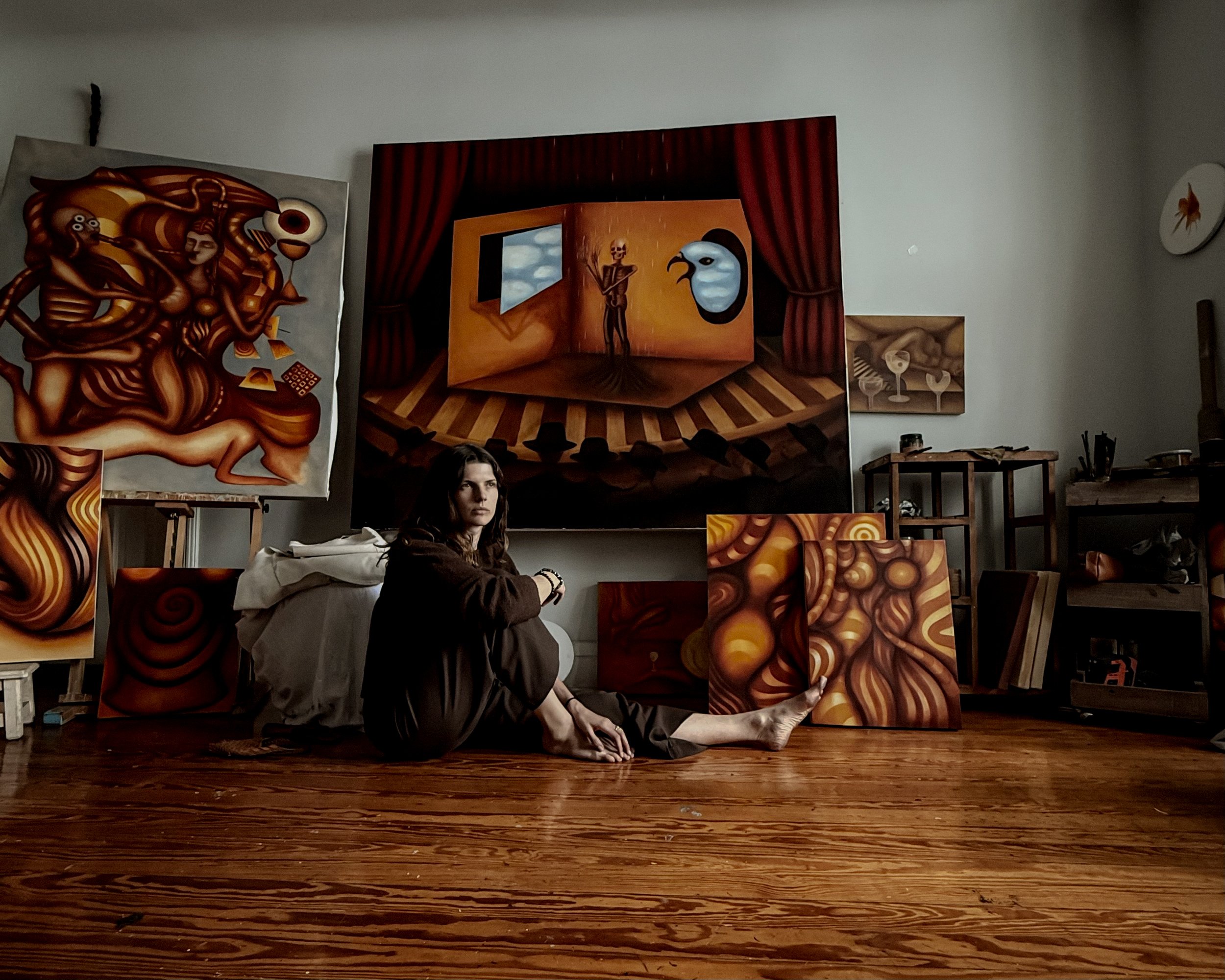
Her paintings continue a lineage that runs through Leonora Carrington, Remedios Varo, and Leonor Fini, women who refused to be muses and painted from the inside out, from the dream, from the dark. Manser carries that work into the present.
At the centre of her work is a wound that is still open. Between the fourteenth and seventeenth centuries, women who held knowledge of nature, herbs, dreams, and the body, who understood how things transform, decay, and renew, were systematically destroyed. They did not need a theory of alchemy because they had the practice. It was the practice that was taken. At the same time, a new image of woman was being constructed: pure, selfless, without darkness or hunger or wild knowing. The two images were enforced together, one could not exist without the other. To make the saint, you had to burn the witch.
What was also destroyed was what Clarissa Pinkola Estés calls the wild woman, the instinctual nature that knows how to descend, how to grieve, how to cross thresholds and come back changed. Not savage, but belonging to itself. The taming of women and the hunting of this inner figure were the same project. Manser's work is an attempt at its retrieval and this is not abstract to her. Manser has stood on both sides of the line that decides which bodies are acceptable to look at - as the one being looked at, and as the one making the image. Both taught her the same thing about what gets erased to produce an acceptable picture of a woman.
What her paintings propose is not a return to the past. It is a retrieval of something that was not lost, but taken. And that the body, in its stubbornness, in its dreaming, has never entirely forgotten.
Her work has been exhibited internationally in New York, Mexico City, Miami, Paris, and Switzerland. Selected exhibitions include Her Time Is Now at Donna Karan's Urban Zen Center in New York, curated by ArtLeadHER; a solo exhibition during Zona Maco at the Four Seasons Hotel Mexico City; and commissioned murals for Art Walk Holistika in Tulum. Manser has collaborated with MeWe International on projects presented at LACMA, including For Freedoms Congress, and on a children's book centred on creativity and storytelling. In 2021, she received the Daniel Lipszyc Award for her Connecting Brains project.
Inquiries / cv / commissions / collaborations: